16 Dec 2025

What Does Value Creation Mean In Private Equity

Strong investment performance across the fund management industry is often attributed to smart decision-making on which companies to invest in. But in private equity, the initial investment decision is just the start.

Typically, private equity funds acquire majority stakes in businesses, buying out the previous owners, whether the vendor is a corporate, a family owner, or public market shareholders.

Majority ownership — which allows control, clear governance, and accountability of a business — is one of the key benefits of the private equity model. It enables private equity firms to provide strategic direction to company management teams and support them as they make decisions and execute changes to drive business improvement.

In private equity jargon, this process is known as ‘value creation’, and it is achieved in several ways.

The early days of the ‘LBO’

When the private equity industry first emerged over 50 years ago, some fund
managers pursued a strategy of acquiring inefficient conglomerates, or their noncore divisions, through investing relatively small amounts of equity alongside high levels of debt. These transactions became known as ‘leveraged buyouts’ or ‘LBOs’.

Fig 1: The private equity industry has constantly evolved its approach to value creation

(Note: this table is illustrative and represents a simplification of industry trends)

Following the early wave of LBOs, the 1990s saw private equity firms focus on driving operational efficiencies in the businesses they acquired. In the 2000s, the corporate environment was generally much leaner, with more efficient balance sheets. Returns therefore had to come from somewhere else.

This saw a period of private equity firms focusing far more on how to create value for their portfolio companies by growing the top line through business expansion and product diversification. This is typically done in two ways: through strategic M&A and organic growth.

An M&A-led strategy, inorganic growth strategy, roll up strategy (also known as ‘buy-and-build’) can rapidly increase a business’s top line. A company can acquire revenues by buying up compatible businesses (or operations), sometimes competitors or adjacent firms, and merging them. Since larger platform companies tend to attract higher earnings multiples (a phenomenon referred to as ‘multiple arbitrage’ from the point at which the private equity fund invested to its realisation of the asset), this can increase returns for private equity funds.

Another important concept is multiple expansion, which occurs when a company’s valuation multiple increases over time. This can happen for two key reasons. First, the overall market may re-rate upward — a trend that benefitted the private equity industry during much of the 2010–2020 period, but which is far less prevalent today. Second, and more sustainably, the business itself becomes higher quality: it grows faster, operates more efficiently, or its financial performance becomes more predictable. For example, a company might improve its pricing model by moving from one-off license fees to recurring subscription revenue, or diversify geographically to reduce exposure to a single market. By making the companies we invest in not only bigger but demonstrably better, private equity firms can capture the benefits of this second, more durable form of multiple expansion.

But today, size alone no longer wins: a private equity firm is less likely to generate an attractive return simply by selling a business that is larger than the one it acquired. Companies must not only be bigger, but also better — with a sustainable future growth trajectory that is clear and compelling for the potential next owner. That’s why private equity’s focus has shifted in recent years decisively towards fundamental business improvement.

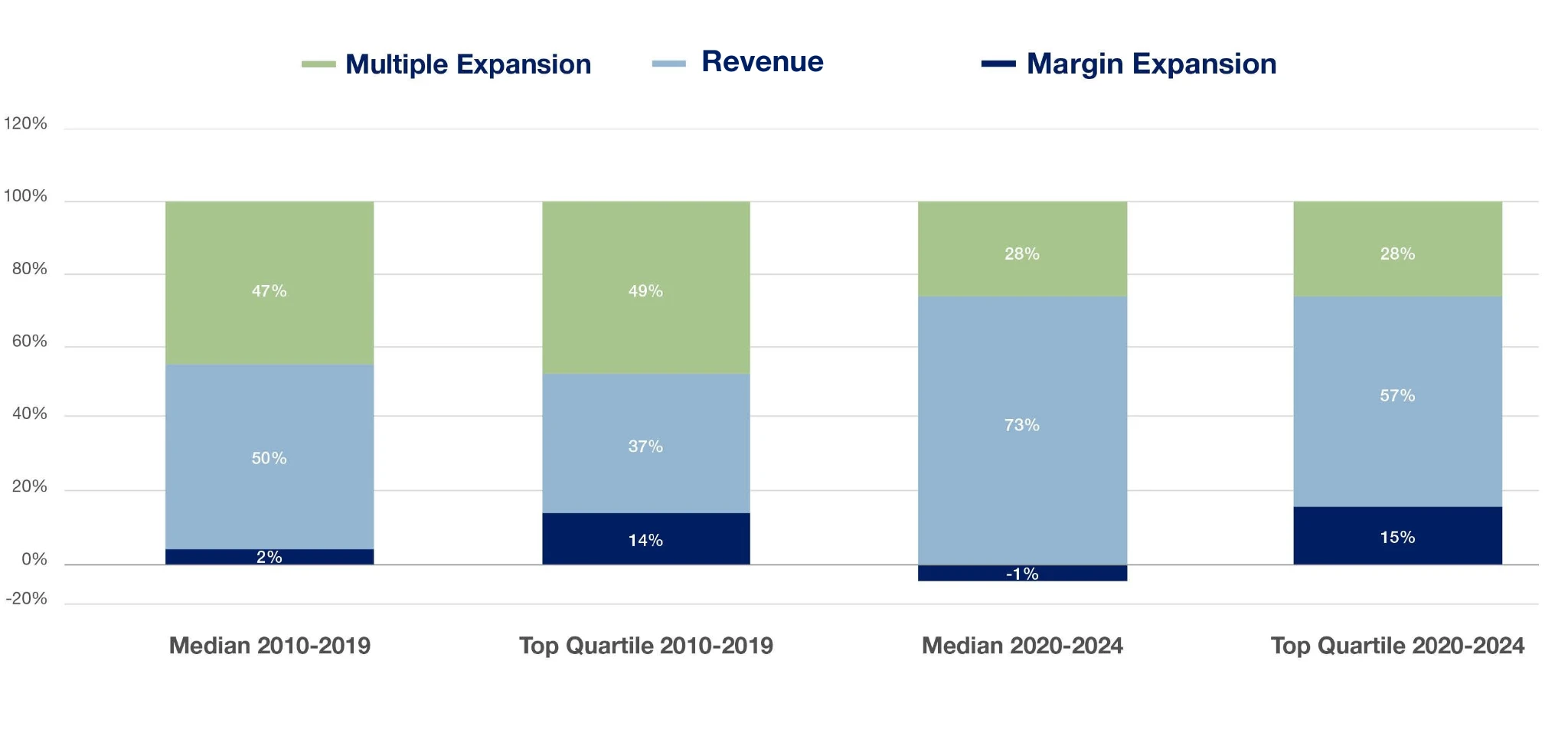
A 2024 study by strategy consultancy Simon-Kucher highlights the shift above. 46% of private equity returns now come from business improvement, eclipsing financial engineering and multiple arbitrages. Organic growth is the main engine — capturing new customers, deepening share of wallet, and investing in relentless innovation to stay ahead of the competition. As with many facets of private equity, averages mask a wide variety of approaches and outcomes. For instance, for Permira’s funds, 74% of returns have been driven by top-line growth and EBITDA margin growth in our portfolio companies.

Traditional value creation strategies still count — multiple arbitrage and margin expansion through operational efficiency remain a focus for buyout firms. But in an investment environment that is becoming increasingly complex, those firms that can blend operational discipline with a deep understanding of growth drivers will be able to successfully accelerate growth through cycles.

Fig 2: Operational improvement continues to grow as the primary driver of private equity value creation


Note: All calculations in $. Includes global buyout and growth deals with initial investments from 2010 – 2024; includes fully and partially realized deals. Value creation levers are calculated by the percentage value contributed by revenue growth, margin expansion, and multiple expansion from deal entry to deal exit.

Source: DealEdge.com. Data as of Aug 2024

Horizontal vs vertical value creation teams

Some firms take a systematic approach to value creation in order to identify similar opportunities for performance improvement across their portfolios. To this end, several firms have developed dedicated value creation teams, comprised of operational experts in specific areas. Permira, for example, has built significant in-house expertise in areas including go-to-market, pricing, SEO, customer insight, and AI.

Typically, value creation teams are organised horizontally according to specific functional competencies and value-enhancing strategies. Even in larger private equity firms — which review a high volume of potential investments and often maintain substantial operational teams — these teams tend to be structured functionally, focusing on areas such as commercial excellence, digital transformation, talent, or sustainability. This functional organisation allows them to apply specialised expertise across portfolio companies, identifying recurring challenges, sharing proven playbooks, and accelerating performance improvements across different sectors and geographies.

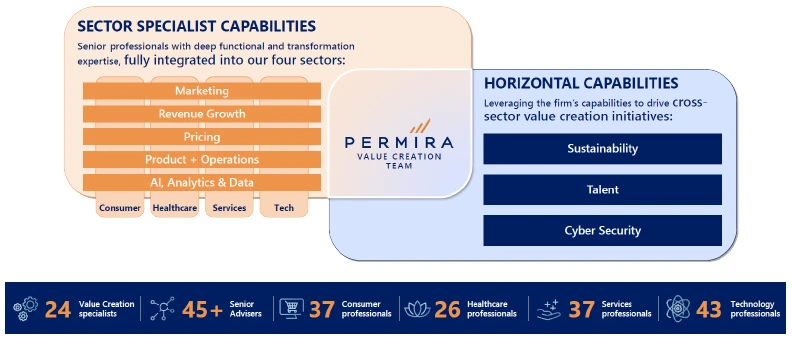
Permira views itself as an exception in this context. The firm’s value creation professionals are embedded vertically within its sector-focused investment teams, in order to bring functional expertise that is relevant and tailored to each specific sector. That’s because it believes that subject-matter competence isn’t enough — it must be grounded and contextualised within sector knowledge and experience.

Fig 3: Permira value creation team combing sector specialists and horizontal capabilities

Source: Permira

Harnessing intangible value

Unless done well, there is a risk of over-simplifying the approach to driving company performance improvement, especially if an overly standardised approach is taken; instead in reality, every business is unique, and implementing any strategy requires flexibility and judgement, this is why we design our value creation plans to combine sector specialists and horizontal capabilities.

Likewise, every private equity firm will have its own value creation approach,
organisational set-up, and ‘style’ of investment.

In the next article, we will look at the importance of culture, diving into how private equity firms assess this critical aspect of any potential investee company, as well as how you should think about the culture of private equity firms themselves.

This document is provided for informational purposes only and should not be construed as an offer, invitation, or general solicitation to buy or sell any investments or securities, provide investment advisory services or to engage in any other transaction.